



The Short Answer: Surface vs Depth
The key difference is how deep each treatment works. Dermaplaning works only on the very top layer of the skin, removing dead skin cells and fine vellus hair, often called peach fuzz, with a sterile blade. Microneedling goes deeper, using fine needles to trigger the skin’s healing response and stimulate new collagen.
Dermaplaning gives instant smoothness and glow. Microneedling changes the skin’s structure gradually. Choosing between them depends on whether you want an immediate refresh or longer-term improvement in texture and scarring.
What Is Dermaplaning?
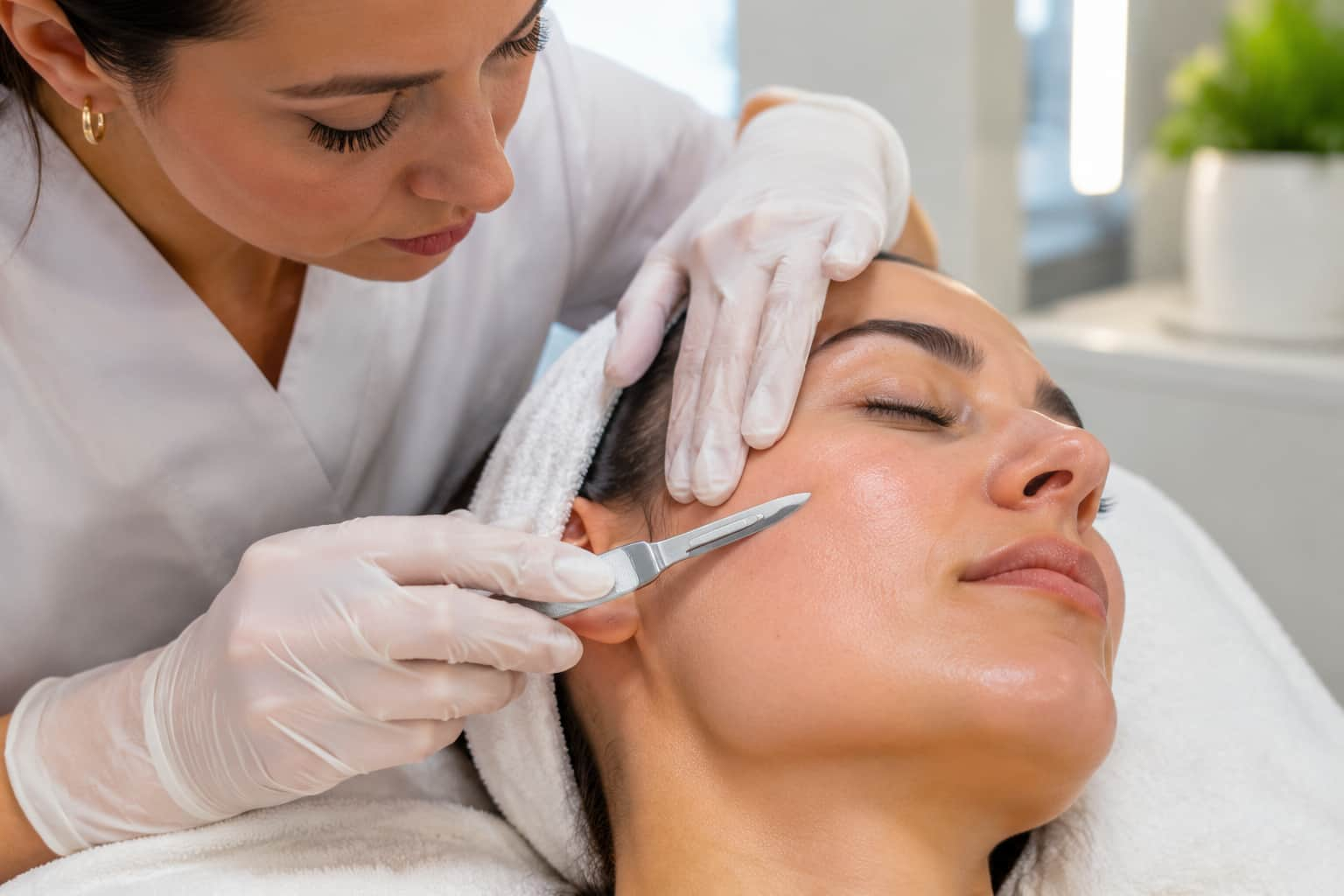
Dermaplaning is a manual exfoliation treatment. A trained practitioner holds a sterile surgical blade at a shallow angle and gently glides it across the skin in short strokes. This removes the outer layer of dead skin cells along with fine facial hair.
The result is skin that looks brighter and feels smoother straight away. Makeup also sits more evenly, and skincare products can absorb more effectively.
Dermaplaning is often chosen for: – Dull, tired-looking skin – Rough or uneven surface texture – Fine facial hair that catches makeup – A quick refresh before an event
What Is Microneedling?
Microneedling, also called collagen induction therapy, uses a device with fine sterile needles to create controlled micro-injuries in the skin. These trigger natural healing, producing new collagen and elastin over the following weeks and months.
Our guide to what microneedling is explains the healing process, device types and session structure in detail.
Microneedling is often chosen for: – Acne scars – Fine lines and early wrinkles – Enlarged-looking pores – Uneven texture and mild pigmentation – Loss of firmness

Microneedling vs Dermaplaning Side by Side
| Dermaplaning | Microneedling | |
|---|---|---|
| How it works | Blade removes dead skin and fine hair | Needles stimulate collagen and elastin |
| Depth | Surface only | Deeper layers of the skin |
| Main benefits | Instant smoothness, glow, better makeup application | Scar improvement, fine lines, pores, texture |
| Results appear | Immediately | Gradually over weeks and months |
| Downtime | None | Usually 1 to 3 days of redness |
| Numbing needed | No | Usually yes |
| Typical frequency | Every 3 to 4 weeks | Every 4 to 6 weeks during a course |
| Typical course | Ongoing as maintenance | 3 to 6 sessions, then maintenance |
Which Treatment Suits Your Concern?
Matching your concern to the right treatment is the most practical way to decide.
| Concern | Better choice |
|---|---|
| Dull skin before an event | Dermaplaning |
| Peach fuzz making makeup look cakey | Dermaplaning |
| Rough surface texture | Either, depending on severity |
| Acne scars | Microneedling |
| Enlarged pores | Microneedling |
| Fine lines | Microneedling |
| Loss of firmness | Microneedling |
| Want an instant result with no downtime | Dermaplaning |
| Want long-term structural improvement | Microneedling |
In practice, many patients first ask for dermaplaning because they want an immediate glow, then move to microneedling once they realise their main concern is texture or scarring that surface exfoliation can’t change.
Results and How Long They Last
Dermaplaning: Results are instant but short-lived. Skin naturally renews its surface every few weeks, so the smoothness and glow typically last three to four weeks. Fine hair grows back over a similar period.
Microneedling: Results build slowly, with some glow in the first week and texture improvements developing over two to three months after each session. Because it stimulates new collagen, results last longer, especially after a full course, with maintenance every three to six months.
Does Hair Grow Back Thicker After Dermaplaning?
No. This is one of the most common worries. Removing vellus hair doesn’t change how it grows. It may feel slightly blunt as it grows back because the tip was cut, but it doesn’t become thicker or darker (American Academy of Dermatology, 2024).
Downtime and Recovery Compared
| Time after treatment | Dermaplaning | Microneedling |
|---|---|---|
| Same day | Smooth, bright skin, possibly slight pinkness | Redness like a mild sunburn |
| Next day | Ready for makeup | Redness fading, may feel tight |
| Days 2 to 3 | Normal | Mild dryness or flaking possible |
| Week 1 | Normal | Skin looks fresher |
Dermaplaning suits people who can’t take any downtime, while microneedling needs a little planning around work and events.
Comfort and Treatment Experience
Dermaplaning is usually painless. Most people describe a light scraping sensation, and many find it relaxing. Treatment typically takes around 30 minutes.
Microneedling involves numbing cream applied for 20 to 30 minutes before treatment. With numbing, most people feel light scratching or vibration. The full appointment usually takes 45 to 60 minutes.
Skin Type Suitability
Both treatments suit many skin types, but there are differences.
- Dry or dull skin: Both can help. Dermaplaning gives instant brightness, microneedling improves long-term texture.
- Oily skin: Microneedling may help with enlarged pores. Dermaplaning is fine but may not address oil-related concerns.
- Acne-prone skin: Neither is done over active breakouts. Dermaplaning is usually avoided with active acne because the blade can spread bacteria. Microneedling is used for scarring once acne is controlled.
- Sensitive skin: Both should be approached carefully. Dermaplaning is usually gentler.
- Darker skin tones: Both are generally suitable, since neither relies on heat or light, though careful technique reduces the risk of irritation and pigmentation.
Who Should Avoid Each Treatment
Avoid dermaplaning if you have: – Active acne or inflamed breakouts – Rosacea flare-ups or very reactive skin – Cold sores or infection in the area – Recent use of strong retinoids or isotretinoin, depending on medical advice
Avoid microneedling if you have: – Active acne, eczema, cold sores or infection in the area – A history of keloid scarring – Pregnancy or breastfeeding – Recent isotretinoin use, depending on medical advice – Certain bleeding disorders
Your practitioner should take a medical history before either treatment.

Can You Combine Microneedling and Dermaplaning?
Yes, but timing matters. Some clinics use a very light dermaplaning pass to prepare the skin before certain treatments, but most practitioners avoid combining full dermaplaning and microneedling on the same day, since together they can over-sensitise the skin.
A safer approach is to alternate them:
| Week | Treatment |
|---|---|
| Week 0 | Microneedling |
| Week 3 | Dermaplaning, once skin has fully settled |
| Week 6 | Microneedling |
| Week 9 | Dermaplaning |
This keeps the surface smooth and bright between collagen-building sessions. Our guide on how often you should get microneedling covers spacing in more detail.
How They Fit with Other Treatments
Both treatments work well within a wider plan.
- Chemical peels: Space peels apart from both treatments to avoid over-exfoliating.
- Skin boosters: Boosters add deep hydration, complementing either treatment.
- Dermal fillers: Avoid either treatment over freshly filled areas for at least two weeks. Our dermal filler treatments in South Kensington are planned with this spacing.
- Anti-wrinkle injections: Usually spaced at least a week or two apart. Our anti-wrinkle treatment in South Kensington can be scheduled around your skin treatments.
Aftercare for Each Treatment
After dermaplaning: – Apply a gentle moisturiser and SPF – Avoid exfoliants and retinol for a few days – Avoid heavy sun exposure, since fresh skin is more sensitive
After microneedling: – Avoid makeup for 24 hours – Use gentle, fragrance-free products for a few days – Avoid retinol and acids for five to seven days – Wear SPF daily and avoid saunas and intense exercise for 24 to 48 hours
Professional vs At-Home Versions
Home dermaplaning tools and microneedling rollers are widely sold, but they’re not the same as clinic treatments.
- At-home dermaplaning tools use safety blades and can remove fine hair, but uneven technique can cause nicks and irritation.
- At-home rollers use very short needles that mainly improve product absorption and carry hygiene risks if not cleaned properly.
Professional treatments use sterile, single-use equipment and trained technique, which gives better results and lowers the risk of infection or damage.
How to Prepare for Each Treatment
Before dermaplaning: – Avoid retinol and exfoliating acids for a few days – Don’t wax, thread or use hair removal creams on the face for a week or two – Arrive with clean skin if possible
Before microneedling: – Avoid retinol and acids for a few days beforehand – Avoid sun exposure and tanning for at least a week – Don’t book within two weeks of a big event – Tell your practitioner about medicines and recent treatments
Which Treatment Is Better by Age?
Age isn’t the deciding factor, but it does influence which concerns are most common.
| Age range | Common choice |
|---|---|
| 20s | Dermaplaning for glow, microneedling for acne scarring |
| 30s | Dermaplaning for regular refresh, microneedling for early fine lines and pores |
| 40s | Microneedling for texture and firmness, dermaplaning between sessions for glow |
| 50s and beyond | Microneedling for collagen support, gentle dermaplaning if skin tolerates it |
Real-World Examples
Wedding in two weeks, dull skin. Dermaplaning a few days before gives instant glow with no downtime. Starting microneedling now risks redness close to the event.
Acne scars from teenage years. Microneedling is the right choice, usually as a course of four to six sessions. Dermaplaning won’t change the scar tissue.
Busy schedule, wants smoother skin and better makeup application. Monthly dermaplaning fits easily around work, with microneedling added later if texture or fine lines become a priority.
Fine lines and enlarged pores in the forties. A microneedling course, with dermaplaning between sessions to keep the surface bright, often gives the best overall result.
What Results Look Like Over Six Months
| Month | Dermaplaning only | Microneedling course |
|---|---|---|
| Month 1 | Instant glow, repeated monthly | First session, mild improvement |
| Month 2 | Same glow maintained | Second session, texture starting to improve |
| Month 3 | Same glow maintained | Third session, noticeable change in pores and fine lines |
| Month 6 | Surface remains smooth with regular sessions | Collagen remodelling continues, longer-lasting improvement |
Dermaplaning maintains a result, while microneedling builds one over time. That’s why many people end up using both.
Safety and Hygiene Standards
Both treatments break or disturb the skin surface, so hygiene is essential. Professional dermaplaning should use a new, sterile blade for every client. Microneedling should use sterile, single-use needle cartridges and a medical-grade device. The skin should be thoroughly cleansed before treatment, and the practitioner should wear gloves throughout.
Treatments carried out in non-clinical settings, or with reused equipment, carry a higher risk of infection and skin damage. Asking how equipment is handled is a reasonable question at any clinic.
Signs You’ve Chosen the Wrong Treatment
If you’ve had several dermaplaning sessions and your skin looks bright but scars or pores haven’t changed, microneedling is likely a better fit. If you’ve had microneedling but mainly want a quick refresh before events, dermaplaning may suit your routine better. Being clear about your main goal at consultation helps avoid spending time and money on a treatment that doesn’t match your concern.
Using Skincare to Extend Results
The right home routine helps both treatments last longer. After dermaplaning, freshly exfoliated skin absorbs hydrating serums well, so a hyaluronic acid serum and a good moisturiser help keep the glow. Between microneedling sessions, daily SPF, gentle cleansing and reintroducing retinol only once your practitioner advises all support collagen and protect the improvements you’ve gained.
Cost Considerations
Dermaplaning is usually less expensive per session than microneedling and doesn’t need a course, but it’s repeated regularly as maintenance. Microneedling costs more per session and is usually booked as a course, though results last longer. When comparing, think about what you want to achieve over a year rather than the price of a single appointment.
Common Myths
- “Dermaplaning makes hair grow back thicker.” It doesn’t change hair growth.
- “Microneedling and dermaplaning do the same thing.” They work at different depths for different goals.
- “Dermaplaning can treat acne scars.” It smooths the surface but can’t remodel scar tissue.
- “Microneedling gives instant results.” Improvements build over weeks and months.
Frequently Asked Questions
Which is better, microneedling or dermaplaning? Neither is better overall. Dermaplaning gives instant smoothness and glow, while microneedling improves scars, fine lines and texture over time.
Can dermaplaning help acne scars? It can make skin look smoother on the surface, but it can’t remodel scar tissue. Microneedling is the better choice for acne scars.
Is there downtime after dermaplaning? Usually none. Most people can apply makeup the same day or the next day.
How often can I have dermaplaning? Every three to four weeks, matching the skin’s natural renewal cycle.
Can I have microneedling and dermaplaning on the same day? Most practitioners prefer to space them a few weeks apart to avoid over-sensitising the skin.
Does dermaplaning hurt? No, most people find it painless and relaxing.
Which treatment is better before a wedding or event? Dermaplaning a few days before gives instant glow. Microneedling needs planning weeks or months ahead.